
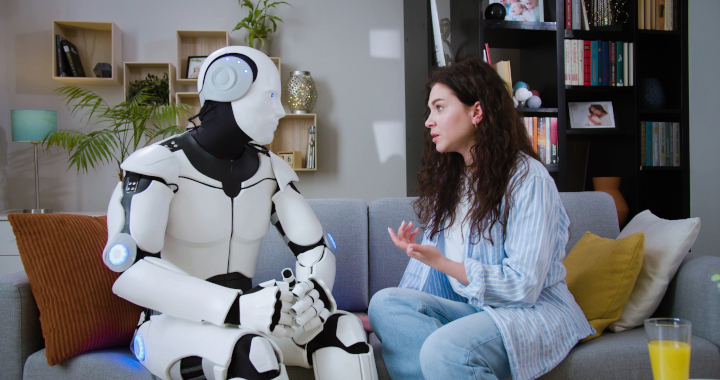
When AI Becomes Your Relationship Advisor
It’s becoming increasingly common for people to ask AI a very personal question:
“Should I stay in this relationship?”
And in many cases, they’re not just asking. They’re listening.
They’re taking what feels like clear, confident, well-reasoned advice, and using it to make decisions about their lives.
I understand the appeal.
AI is available at any time. It responds quickly. It doesn’t interrupt, it doesn’t get emotional, and it doesn’t seem to judge. For someone who feels stuck, overwhelmed, or unsure where to turn, that can feel like a relief.
But there is something important to understand about what AI is and what it isn’t.
What AI Can Do Well
AI is a very good tool.
It can help you organize your thoughts. It can summarize information, outline options, and even help you see patterns you may not have noticed. For practical tasks, putting together a budget, thinking through logistics, or preparing questions, it can be incredibly useful.
Where Things Start to Shift
The concern isn’t that people are using AI.
It’s that they’re beginning to rely on it for decisions that are deeply personal, complex, and emotional, especially when it comes to relationships.
Because while AI can sound thoughtful, what it is actually doing is reflecting patterns in words and phrases. AI is a large language model. That means that its only resource is words, not compassion, empathy, context, nuance or even reason. It draws on vast amounts of human conversation and presents what appears to be a clear, reasonable conclusion.
The difficulty is that those patterns are not neutral.
They are shaped by the voices that created them, people sharing opinions, experiences, frustrations and advice, often in moments of stress or conflict.
So when someone turns to AI and asks, “Should I stay or should I go?” what they’re often receiving is not guidance grounded in their unique relationship, but a kind of averaged response based on how others have reacted in similar situations.
That can feel convincing.
It can also be misleading.
Why It Feels So Trustworthy
Part of what makes AI advice so compelling is how it sounds.
It is calm. It is structured. It often presents multiple perspectives before gently leading toward a conclusion. It can feel balanced and fair, even when it’s simplifying something that isn’t simple at all.
And perhaps most importantly, it feels safe.
There’s no risk of being misunderstood. No fear of being judged. No complicated emotional response coming back at you.
For many people, that makes it easier to open up.
But there is a difference between something that feels safe and something that is actually helping you make a thoughtful decision.
Relationships Are Not Optimization Problems
One of the subtle shifts that happens when people rely on AI for relationship advice is that the relationship itself starts to be framed as a problem to solve.
- Is this working or not?
- Is this good enough or not?
- Should I stay or should I leave?
Those are understandable questions.
But relationships are not built on clean, binary decisions. They are built on ongoing conversations, adjustments, misunderstandings, repair, and growth over time.
They involve two people, each with their own history, expectations, and ways of communicating. They evolve. They require effort.
And most importantly, they require participation.
You cannot outsource that.
What Gets Lost in the Process
When someone relies too heavily on outside advice—whether that’s from AI, the internet, or even well-meaning friends, there is a risk of skipping an important step:
The conversation with the person you’re actually in the relationship with.
It is often easier to ask a third party what you should do than it is to sit down and say:
- “This is what I’m struggling with.”
- “This is what I need.”
- “This is what doesn’t feel right to me.”
Those conversations are not always comfortable. They require vulnerability. They require patience. And they don’t always lead to immediate clarity.
But they are where real understanding and connection happens.
What I See in Practice
In my work, I meet people at many different stages of their relationships—some at the beginning, some at the end, and many somewhere in between.
One pattern I see consistently is this:
The decisions that have the most lasting impact are often made without enough conversation beforehand.
Not because people don’t care, but because they avoid the harder discussions until they feel unavoidable.
By the time those conversations finally happen, the relationship is already under strain. Emotions are high. Trust may be eroded. And it becomes much more difficult to work through things in a constructive way.
That’s not a technology problem.
a human one.
A Different Approach
This is part of why I talk about Premarriage Planning Agreements (PPAs) as something more than a legal document.
At their best, they are a structured way to have conversations that most couples don’t otherwise have, about money, expectations, roles, and what each person needs to feel secure in the relationship.
They create space to ask:
- What are we building together?
- What does fairness look like to each of us?
- How do we want to handle difficult moments when they arise?
Those conversations are not always easy. But having them early, when the relationship is strong, changes the dynamic completely.
It allows decisions to be made thoughtfully, rather than reactively.
If you’re interested in how that process works, you can learn more here:
https://masterscdc.com/premarriage-planning-agreement/
And if you’re not sure whether you’ve had these conversations yet, this is a helpful place to start:
https://masterscdc.com/pre-marriage-readiness-quiz/
Where AI Fits—And Where It Doesn’t
AI can be a useful tool in this process.
It can help you think through questions you may want to ask. It can help you organize your thoughts before a conversation. It can even help you clarify what you’re trying to say.
But it cannot replace the conversation itself. It cannot feel the emotions you and your partner are feeling before, during and after the conversation. It cannot anticipate the curves your partner may throw at you—the good surprises that are relief and not so good ones that point to the need for deeper understanding.
It cannot understand the full context of your relationship. It cannot see how you and your partner interact, how you repair after conflict, or what is possible between the two of you with effort and intention.
And it cannot take responsibility for the outcome of the decisions you make.
Final Thought
There is nothing wrong with seeking input when you feel uncertain.
In many ways, that’s a sign that you’re taking your relationship seriously.
But some decisions require more than input. They require engagement.
They require you to sit down with your partner, talk honestly, listen carefully, and work through things together—even when it’s uncomfortable.
AI can help you think.
It can help you prepare.
But it cannot decide how you want to live your life or how you want to show up in your relationship.
That part is still yours.